Late Stage Democracy
How a wealthy, stable democracy perfected the procedural arts of not quite getting around to it.
Late Stage Democracy
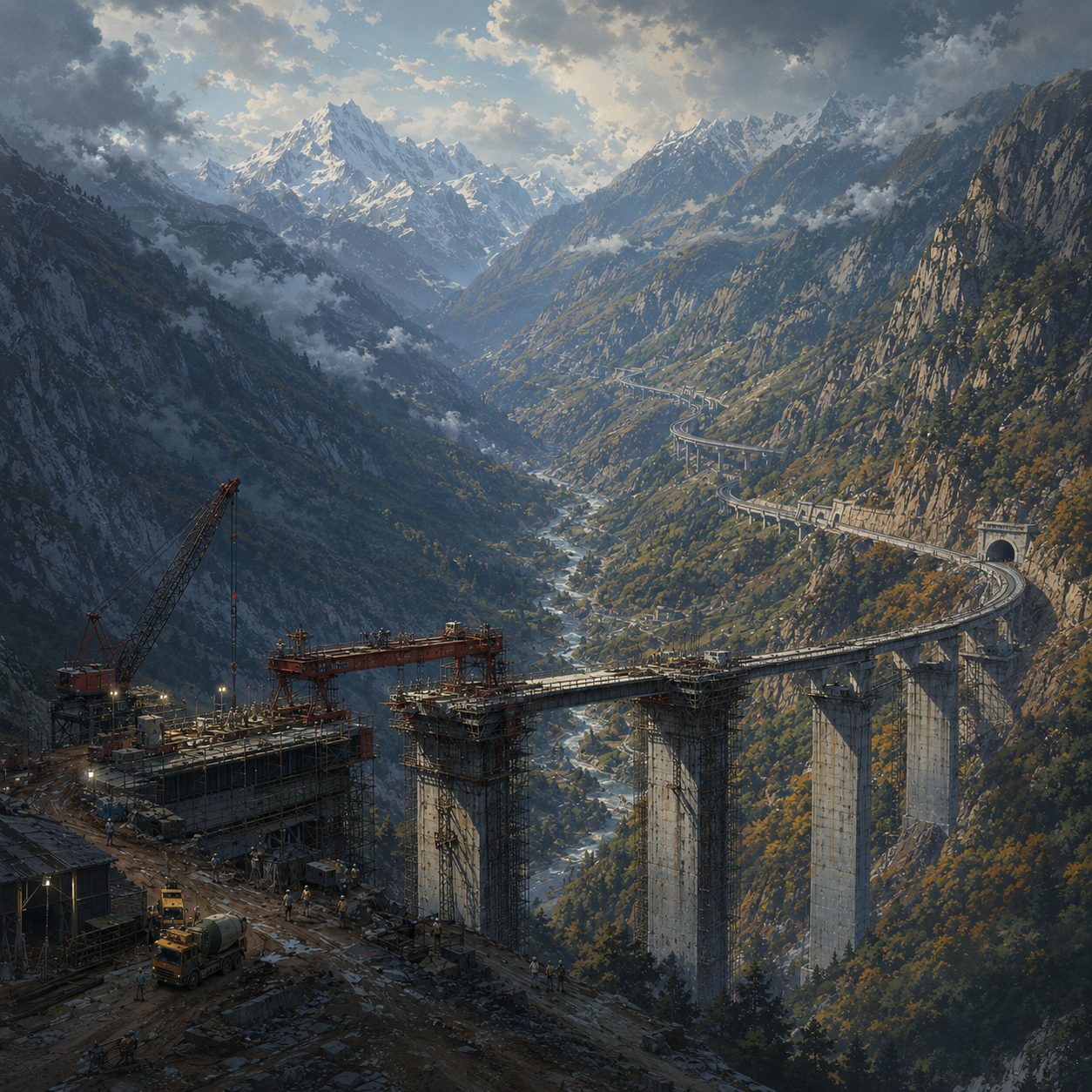
Somewhere in the Hengduan Mountains, workers are boring a tunnel through seismically active rock at 4,500 metres above sea level. The Sichuan-Tibet Railway — 1,629 kilometres from Chengdu to Lhasa — is roughly 95 percent bridges and tunnels on its most challenging section, threading through gorges, fault lines, and some of the most geologically hostile terrain on the planet. The total cost of the entire project is around $48 billion USD. It is, by any engineering measure, one of the most extraordinary infrastructure undertakings in human history.
Now consider what Australia, a rich, stable, English-speaking liberal democracy, was attempting to build for a comparable sum: a freight railway across a flat plain.
The Inland Rail was a proposed 1,600-kilometre freight corridor capable of running 1.8-kilometre-long, double-stacked trains between Melbourne and Brisbane. No mountains. No seismic zones. No tunnels of any consequence. Mostly cleared agricultural land that has been traversed by roads and fences for over a century. The terrain’s most formidable feature was, in places, a slight gradient. The project was first funded in the 2017-18 federal budget, and over a decade became a symbol of administrative failure — costs blowing out from $16 billion in 2020 to $31 billion by 2022, and ultimately to a projected $45 billion to complete. This week, the Albanese government confirmed it will be stopped at Parkes — effectively abandoning the northern legs entirely, leaving the only completed work as upgrades to tracks that already existed. Let that comparison breathe for a moment. China is tunnelling through the Tibetan Plateau. Australia couldn’t lay track across New South Wales.
The standard response to this observation is to invoke governance, democracy, and the virtues of consultation. And here is where we must be precise, because the defenders of process have a point — just not the one they intend to make. The consultation was real. The environmental assessments were conducted. The stakeholder engagement rounds were held, the community forums convened, the independent reviews commissioned. All of this, note, on flat land that a nineteenth-century engineer with a theodolite and a gang of labourers could have surveyed in a season.
We have developed, over several decades, a philosophy of infrastructure delivery that mistakes thoroughness for capability. Every new layer of review, every additional round of consultation, every redrafted environmental impact statement is presented as evidence of a mature, responsible state. What it is, in practice, is evidence of a state that has lost the capacity to decide. Late-stage capitalism gets its share of cultural criticism — the term conjures images of financial abstraction eating the productive economy. But we lack an equivalent vocabulary for what is happening to democratic governance: the proliferation of process until process becomes the product, the endless deferral of actual construction while the consultancy invoices accumulate, the capture of public institutions by the very stakeholders they were meant to navigate. Call it late-stage democracy. Its signature achievement is the scoping study that never scopes, the review of the review, the project paused for four years while inflation does the killing quietly in the background.
At the centre of this failure is a question that the Schott Review — the 2023 independent audit that documented Inland Rail’s governance collapse — somehow never quite asked: who, specifically, is responsible? The review named failures. It described years of poor governance at the Australian Rail Track Corporation. It catalogued cost blowouts, mismanagement, and shifting political priorities with the exhaustive thoroughness that Australians have learned to expect from reviews that recommend further reviews. What it did not do, could not do within its terms of reference, was name a single person who lost their job. ARTC’s board rolled on. The minister emphasised the need to “get delivery arrangements right.” The consultants submitted their invoices. The project died of a thousand responsible parties.
This is not an accident of personality or politics. It is the structural consequence of how Australia builds things — or rather, how it avoids building them. The Commonwealth announces the project. A statutory corporation nominally delivers it. An independent authority reviews it. The minister manages the politics of it. The states contest the alignment through their own planning jurisdictions. When cost blowout occurs, accountability dissolves across this archipelago of agencies like salt in the ocean. Everyone is responsible in theory. Nobody is responsible in practice. The architecture of modern Australian public administration has been optimised, with remarkable precision, for the diffusion of blame.
Compare this to how China structures accountability for the Sichuan-Tibet Railway. The project director carries career consequences for delivery — timelines, budgets, and engineering outcomes are attached to individuals whose advancement depends on results. The institutional incentive runs toward completion, not toward the elegant management of non-completion. More fundamentally, the political authority that decides to build the railway is also the authority responsible for delivering it. Decision and execution are not separated by layers of arm’s-length corporations designed, in part, to insulate ministers from operational failure. When something goes wrong in the Hengduan Mountains, the chain of accountability is short and the consequences are real.
There is a second, less discussed dimension to this accountability gap, and it operates further upstream — before a single metre of track is laid. The Sichuan-Tibet Railway’s feasibility and engineering work was conducted by state institutions with decades of accumulated in-house expertise. The cost estimates emerged from engineers who would be held responsible for the accuracy of those estimates, working within organisations whose institutional memory stretched back through the Qinghai-Tibet Railway and beyond. The original numbers reflected genuine engineering knowledge. Inland Rail’s cost estimates were produced by the same consulting ecosystem that would subsequently bid for delivery contracts. The incentive structure here is not subtle: a consultant who estimates a project at $16 billion wins the political approval that generates the work; a consultant who estimates it at $45 billion does not get the commission. The low-ball estimate is not a mistake. It is a business model. The cost blowout that follows — from $16 billion to $31 billion to $45 billion over barely five years — is not evidence of unforeseeable complexity on a flat plain. It is the entirely foreseeable consequence of a system that has externalised its engineering knowledge to a private sector with no institutional interest in projects being finished, only in projects being started.
The bureaucrat who recommends caution, commissions another review, or formally advises a pause is insulated from consequences in a way their Chinese counterpart simply is not. Nobody in Australian public life gets sacked for the railway that wasn’t built. The rational response to this incentive structure is to never build. An infrastructure minister who cancels a project can always blame the previous government’s costings; an infrastructure minister who completes a project owns every cost overrun. The result is a political economy of elegant inaction: reviews that recommend further reviews, pauses that become cancellations, and announcements of ambition that substitute, with remarkable efficiency, for the thing announced. The government that cancelled Inland Rail simultaneously ordered a scoping study for high-speed rail between Sydney and Newcastle, estimated at between $70 and $90 billion — a project that will be scoped, reviewed, consulted upon, and quietly shelved within the decade.
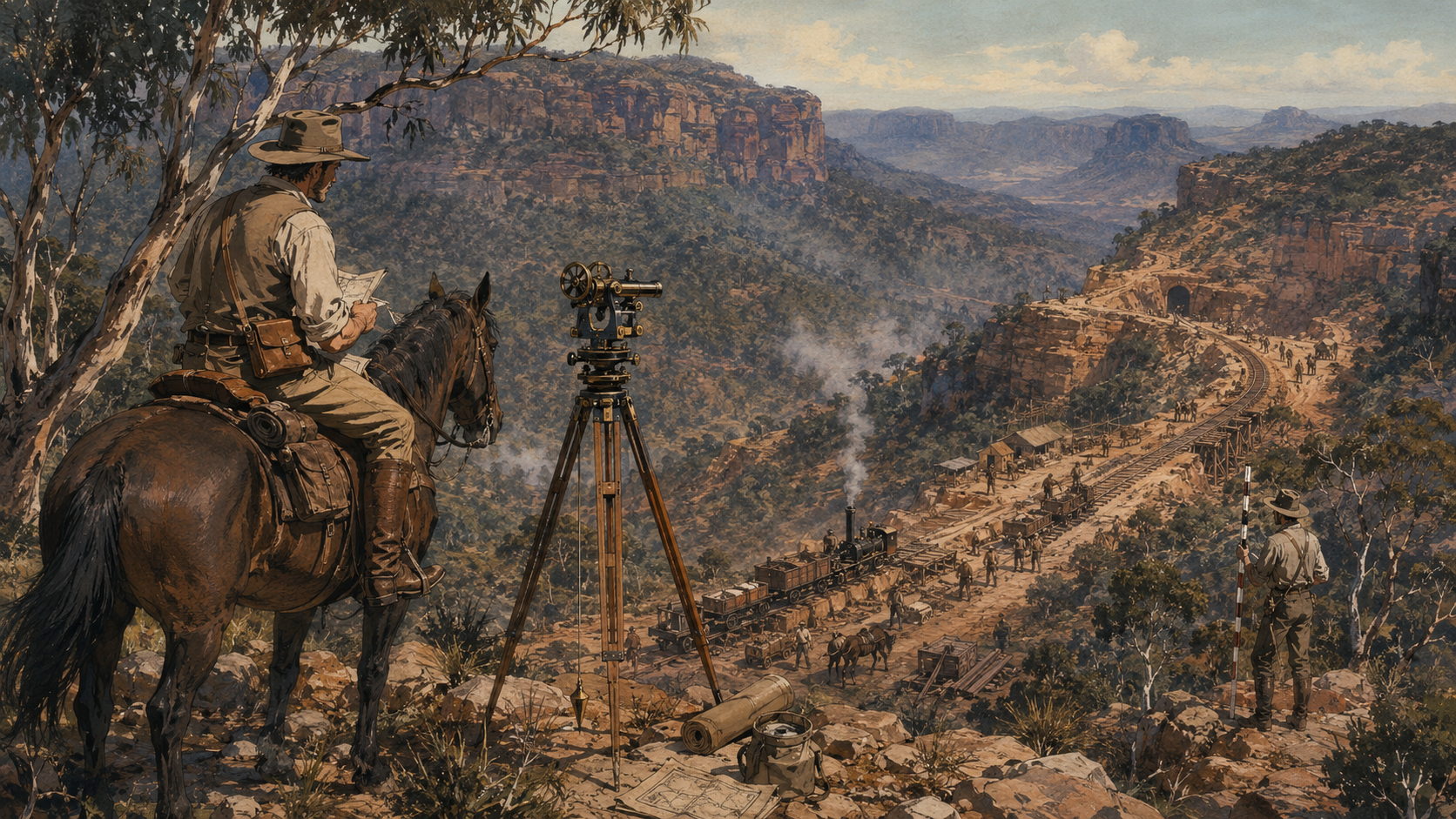
The liberal democratic state was not always like this. The Snowy Mountains Scheme was not designed by committee. The Sydney Harbour Bridge was not paused for stakeholder re-engagement. The Overland Telegraph crossed 3,000 kilometres of unmapped desert in two years. What changed was not the terrain. What changed was the class of people who run things, and the incentive structures that reward their behaviour. A permanent bureaucracy that is never held accountable for projects not built is held accountable, viciously, for projects built badly. The rational bureaucrat learns this lesson early and carries it faithfully into every subsequent ministerial briefing.
One may hold serious objections to the political system that makes Chinese infrastructure execution possible — and one should. The Sichuan-Tibet Railway serves strategic and demographic purposes that have nothing to do with the welfare of Tibetans, and accountability systems that punish failure can also punish honesty. These are not trivial objections. But intellectual honesty requires acknowledging what has been lost on our side of that ledger. The question is not whether we would trade our institutions for theirs — we would not, and should not. The question is whether we have allowed our institutions to degrade to the point where we can no longer do things that nineteenth-century colonial governments, with a fraction of our resources, did as a matter of administrative routine.
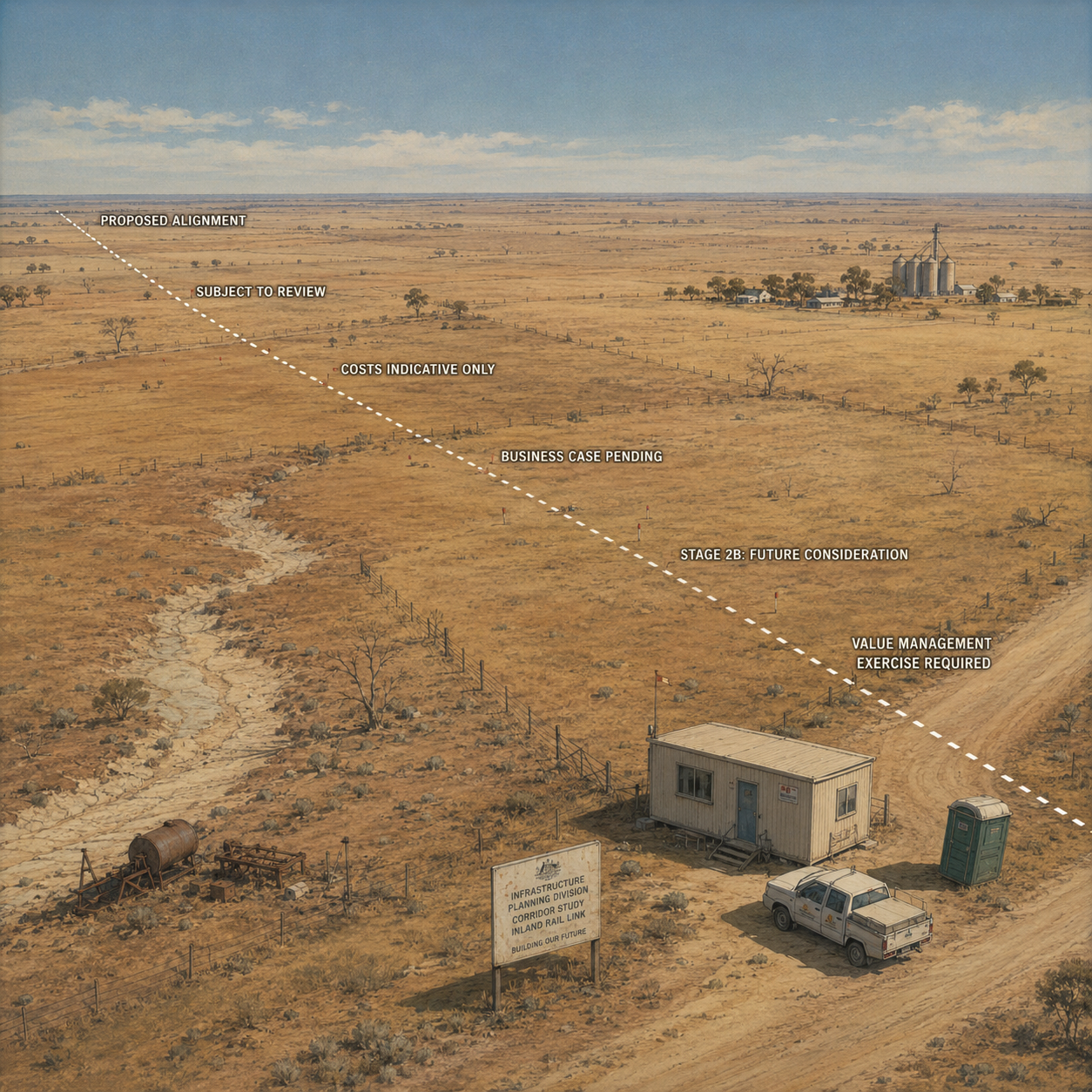
Australia is, by any global measure, a country that should be able to build a railway across a plain. The fact that it cannot is not a funding problem, not a technical problem, and not even, at root, a political problem in the partisan sense — both the Coalition that announced Inland Rail and the Labor government that strangled it over four years of expensive inaction share the honours here. It is a civilisational problem. A question of whether a wealthy, educated, stable society retains the collective will to do hard things, or whether it has perfected, instead, the thousand procedural arts of not quite getting around to it.
In the Hengduan Mountains, the tunnelling continues.